Beginner Guide
Build an early route around unlocks, gear, materials, and risk control.
Stabilize the route before chasing rarity or market value.
Quick Take
- 1
Unlock core systems before chasing prices
- 2
Judge gear by level and slot first, not rarity
- 3
Keep tradable or effect-bearing materials
- 4
Use only real market data — no invented numbers
- 5
Farm stable stages before pushing harder ones
Opening Goal
The first goal is not finding the most expensive item or chasing the rarest drop. Instead, build a stable loop around four foundations: stage unlocks, full gear slot coverage, basic material stockpiling, and hero growth.
Every farming run should answer three questions: 1. Clear reliability — Can you clear this stage consistently without deaths that cut efficiency? 2. Slot improvement — Did any drop improve your level or slot coverage? Gaps in armor, shield, or weapon matter more than missing accessory slots. 3. Material value — Does the material have a clear use for Decoration, Engraving, or Inscription? If yes, keep it. If not and it's tradable, check market data before selling.
Gear Handling — Level First, Rarity Second
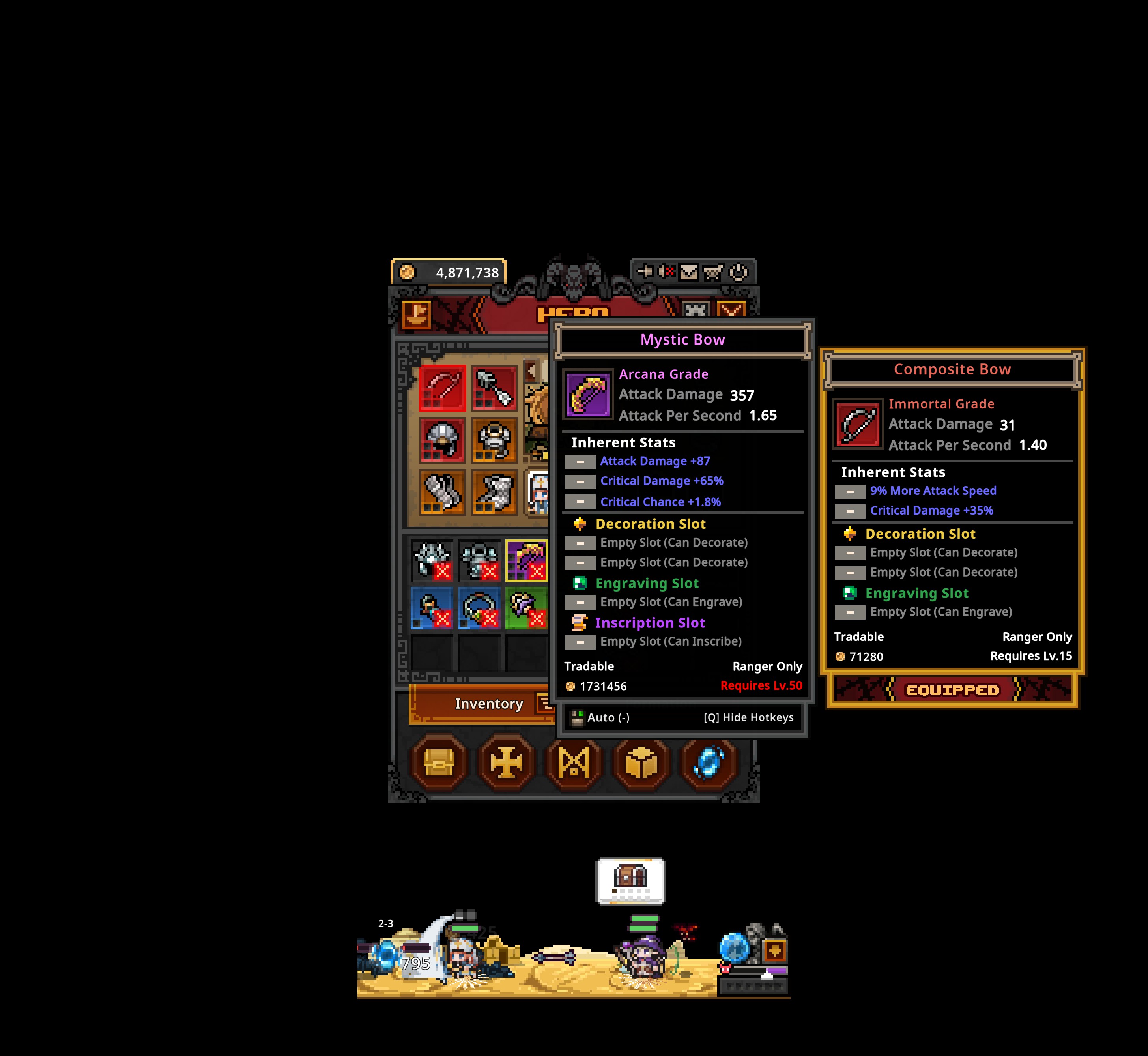
Gear power comes primarily from item level, not rarity color. A Common level-50 sword will outperform a Legendary level-20 sword in raw damage. This is the single most important concept for new players.
Judge every gear drop by this priority order: 1. Slot coverage — Does it fill an empty slot? If yes, equip it regardless of level. 2. Level gap — Is it 5+ levels higher than your current piece in the same slot? If yes, test it. 3. Rarity — Only compare rarity when levels are similar (within 5 levels). 4. Special effects — Material affixes and Cube stats matter later. Don't discard gear just because the effect name is unfamiliar.
Weapon Priority Weapons directly improve clear speed. Upgrade your **main weapon first** — it contributes more to damage than any other single piece. For classes with dual weapons (Knight's Sword + Shield, Ranger's Bow + Arrow), upgrade the primary hand before the offhand.
Defense Priority Armor and shields keep you alive. If you die even once per run, your effective gold/XP per hour drops significantly. A full clear with lower damage often beats a risky clear with higher damage. Check your death count before declaring a stage "farmable."
Accessories Rings, amulets, and belts become important once clears are reliable. They provide secondary stats like critical chance, movement speed, or cast speed that fine-tune your build. Don't obsess over accessory slots until your weapon, armor, and shield are at-level.
Material Handling — Don't Sell Blindly
Materials connect gear, Cube crafting, and market trading. The instinct to sell everything for bag space is the most common early-game mistake.
Material Decision Order 1. **Tradability** — Is it tradable on the Steam Market? Materials are generally easier to match and sell than gear. 2. **Effect relevance** — Does the material's effect type (Decoration, Engraving, Inscription) match your class's stat priorities? 3. **Scarcity** — High-tier materials (soulstones, scrolls, rare gems) often have limited supply. Keep them until you understand their value. 4. **Market data** — If real market data exists, check the lowest listing AND the number of listings. Low supply with zero recent sales = uncertain value.
Categories to Know - **Gems and ores** — Used for Cube stat crafting. Ruby (damage), Sapphire (defense), Emerald (utility), Diamond (premium). - **Soulstones** — Scale by difficulty tier (Normal, Nightmare, Hell). Required for advanced Cube operations. - **Scrolls** — Inscription and engraving scrolls apply specific affixes to gear. - **Leather and cloth** — Used across multiple crafting recipes; watch for tradability.
When real market data is missing for a material, mark it as watchlisted rather than valuing it at zero or listing it blindly.
Progression Route — Stable Over Ambitious
Stage Selection Farm the highest stage you can clear **consistently** — defined as zero or near-zero deaths across 10+ runs. If a higher stage takes twice as long or causes deaths, a lower stage is always better for gold and XP per hour.
Route Testing Before committing to a farming route: 1. Run it 5 times and record clear time, deaths, and notable drops. 2. Calculate gold per minute and XP per minute. 3. Compare against your current best route. 4. If the new route is within 10% but causes deaths, stay on the safer route.
Tool Usage The profit calculator and farming compare tools require clear time input. Enter your **actual average clear time**, not an aspirational number. If drop rates or market prices are missing, the tools will show that data is unavailable — this is intentional and prevents misleading profit estimates.
First Week Roadmap

- Days 1-2: Unlock all six gear slots. Farm the highest normal stage you can clear without deaths. Keep all materials.
- Days 3-4: Push to at least Act 2. Start paying attention to gear levels. Replace anything 10+ levels behind.
- Days 5-7: Check tradable status on your materials. Read the Steam Market guide. Open the Cube guide if you have enough materials to start crafting.
- Week 2+: Start comparing hero classes. Pick a farming route from the gold or XP guide. Use the build pages as references, not absolutes.
Common Mistakes
Chasing rarity too early
Treating tradable as automatically valuable
Talking about market profit without clear time
Selling all materials because bag space
Ignoring stage stability for higher level number
FAQ
What should I farm first
Farm the highest stage you can clear consistently — not the highest stage you can barely clear.
When should I check the market
After you start seeing tradable materials or gear. Before that, focus on stage unlocks and gear slots.
Should I keep every item
Replace low-level duplicates that share the same slot, but keep materials with clear effect types.
When is an item worth selling
After checking self-use value, then market data, then supply. Never sell based on rarity alone.
How do I know if my gear is good enough
Aim for 80%+ slot coverage at or near your current stage level. Gaps in armor or weapons hurt more than missing accessories.
What's the most common beginner trap
Equipping a rare item that is 20+ levels lower than your current gear just because it's a higher rarity.


